
What Drives Builders’ Launches in NCR: A Buyer’s Guide
Updated October 18, 2026
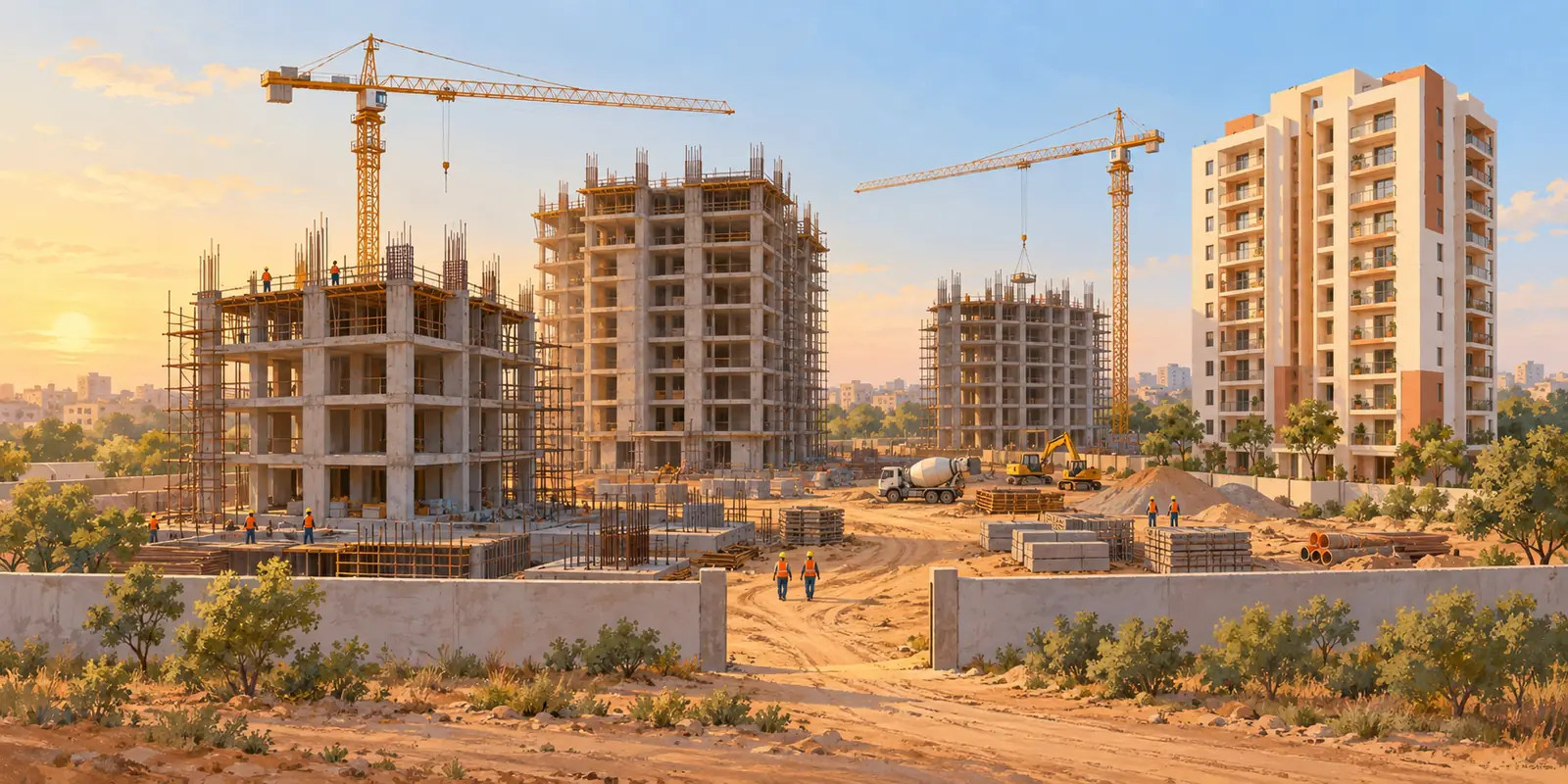
New project launches in Delhi NCR can look like pure marketing. In practice, a launch is a financial decision. A builder needs land, permissions, buyers and cash, and all four have to line up. If you understand those pressures, you can read a launch announcement more calmly and ask better questions.
This guide covers the main forces behind launches, then shows how to check a developer’s health before you commit money. It is general information, not investment advice, and nothing here predicts prices or returns.
1. Land and approvals come first
A builder cannot launch without land it controls and sanctioned plans. In Noida, Greater Noida and the Yamuna Expressway area, much of the land comes from development authorities, so the builder’s relationship with the authority matters a great deal.
That relationship has real consequences. The Noida Authority has halted approvals for building maps and layout changes in several group housing projects where dues are pending. It has also begun rejecting extension requests from developers who have not cleared what they owe. That report is from 2025, so check the current position before relying on it. The point stands: unpaid dues can freeze a builder’s permissions.
On the regulatory side, a project bigger than 500 square metres or with more than eight apartments must register with UP RERA. Registration is the starting gate for legal sales, and it adds time between land purchase and launch.
I could not verify current land-allotment prices or floor-area rules for this article. They change with authority notifications, so check the authority’s own website for any sector you are considering.
2. Demand decides timing
Builders launch when they think they can sell. The latest data shows a cautious NCR. Anarock reports that NCR sales fell 1% to 13,765 units in Q3 2026, and that NCR was among the markets where developers pulled back, with new launches down 14% year on year to 10,900 units.
Compare that with the national picture. Across the top seven cities, sales rose 3% to 1,00,220 units while launches jumped 18% to 1,14,320 units. The same report says unsold stock across those cities rose 12% to about 6,30,590 units. I did not find an NCR-only inventory figure, so treat that number as a national signal.
As festive season sales begin, some NCR developers are adding perks. Incentives include foreign holidays, electronics, modular kitchens and flexible payment plans. Read these offers as a sign that builders are competing for buyers. Compare the actual price and payment schedule, not the gift.
3. Interest rates change both sides of the sum
Rates affect buyers’ EMIs and builders’ borrowing costs. On 7 October 2026, the RBI’s Monetary Policy Committee voted unanimously to raise the repo rate by 25 basis points to 5.50%. This was the first hike since February 2023, and the RBI also changed its stance to “calibrated tightening”.
For floating-rate borrowers, the hike applies from the next scheduled interest reset date. One estimate puts the extra cost at about ₹1,589 a month on a ₹1 crore loan. The source does not state its tenure assumptions, so ask your lender for your own figure.
Higher rates can make buyers more careful and make builders’ project loans costlier. Whether that slows launches further is not yet clear. The next policy reviews will show more.
4. RERA escrow limits how builders use buyers’ money
This rule shapes launch economics more than most buyers realise. Under Section 4(2)(l)(D) of the RERA Act, developers must deposit 70% of money received from buyers into a separate account at a scheduled bank. It can be used only for the land and construction costs of that project.
Withdrawals must match the stage of construction and be certified by an engineer, a chartered accountant and an architect. The accounts must also be audited every year. The detailed forms and procedures come from each state’s own rules.
In practice, this means a builder cannot easily use Project A’s collections to fund the land for Project B. Only the remaining 30% is free for other uses. That is my reading of the rule, not a statement from any source. It helps explain why builders often want strong pre-launch funding, or a clear sales pace, before they start.
5. Authority dues: the hidden brake in Noida, Greater Noida and YEIDA
In Noida and Greater Noida, builders often bought land from the authority in instalments. Unpaid balances can block occupancy certificates and registries, and can stop fresh permissions.
A recent report says builders owe about ₹40,000 crore, roughly ₹26,000 crore to the Noida Authority and nearly ₹14,000 crore to the Greater Noida Authority. The same report says 21 completed projects in Noida could not get registries because of pending dues. The figures change, so treat them as a snapshot.
Relief schemes exist, but they are not automatic. Under a rescheduling scheme, developers can pay up to 20% of dues upfront and clear the rest over two years. Separately, a September 2026 report says Noida Authority issued notices to 23 builders in stalled projects who had not cleared the required dues. It adds that registration of 6,807 of 21,034 previously unregistered flats was complete. The authority has also warned it may seal unsold units and builders’ offices, and take over vacant land and under-construction buildings.
For the Yamuna Expressway area, I found no current builder-dues figures for YEIDA. One report says YEIDA approved a budget of over ₹11,000 crore, with around ₹7,500 crore expected from recovery of dues. That shows the authority depends on dues recovery. It does not tell you anything about an individual builder. Ask the authority directly about any project there.
A builder with large unpaid dues may struggle to get approvals. A builder who has settled its dues may find launching easier. Either way, a launch is not proof of financial health.
6. How to judge a developer’s health
No single test is enough. Combine several checks, and keep copies of what you find.
- Search the UP RERA portal. You can search by project name, RERA number or promoter. The project page shows the registration certificate, approved layout, registered completion date and quarterly report status.
- Read the quarterly progress reports. Builders must file them every three months, and late filing can signal delays or disputes. UP RERA recently extended the deadline for the July–September 2026 quarter. Check the filing dates, not just whether reports exist.
- Look at the promoter’s other projects and complaints. The promoter page lists registration status, all registered projects and complaint history. Compare promised and actual completion dates on earlier projects.
- Check authority dues. Noida Authority has published a list of 115 group housing projects on its website. Look for a project’s status and any pending dues, and ask the builder for a written no-dues position. Rules on no-dues certificates and occupancy certificates have changed over the years, so confirm the current requirement with the authority.
- Scan for the QR code. Since 18 July 2024, new UP RERA projects receive a QR code that must appear on brochures, ads, booking forms and agreements. Scan it and check it opens the same project you were shown.
- Ask about the escrow account. Ask for the project’s RERA account details and how withdrawals are certified. A reluctant answer is worth noting.
- Compare launch pricing with ready or nearly ready options. If a new project is priced far above comparable homes, ask why. The ADiHomes property search lets you compare listings side by side.
7. Putting it together for your search
A launch tells you the builder expects to sell, nothing more. Before paying a booking amount, confirm RERA registration, read the agreement and check the approvals listed on the portal. Then look at the builder’s record of delivering earlier projects.
If you are shortlisting areas, the ADiHomes guides to Greater Noida West, Noida Expressway and Yamuna Expressway are a useful starting point. Each area sits under different authorities and has different projects, so the checks above apply to each one separately.
Finally, remember that rules, rates and dues figures change. Re-check the RERA portal and authority notices close to your booking date, and take advice from a qualified lawyer or financial adviser for your own case.
Sources
- RBI hikes repo rate to 5.50%; shifts policy stance to 'calibrated tightening' (SCC Online)
- RBI Repo Rate Oct 2026: 5.50% After the October 2026 Hike (Shoonya)
- RBI Hikes Repo Rate by 25 bps to 5.50% (CorpLaw Updates)
- MMR, Bengaluru drive Q3 housing sales (Storyboard18, Anarock data)
- Housing sales rise 3% to one lakh units in Q3 2026; launches up 18%: Anarock (PropNewsTime)
- Developers roll out festive offers as homebuyers weigh higher borrowing costs (PropNewsTime)
- How RERA's Escrow Mandate is Boosting Buyer Confidence (Castler)
- The RERA 70% Escrow Rule: How Builders Must Comply (Patron Accounting)
- Noida Authority Classifies 80-90 Group Housing Builder Projects as Defaulters (RP Realty Plus)
- Noida Authority Issues Notices to 23 Defaulting Builders Over 75% Dues (H4E News)
- Noida Authority Takes Stern Measures Against Builders Over Pending Dues (Apartment Times)
- YEIDA plot schemes 2026 (99acres)
Updated 18 October 2026. This article is general information, not legal or financial advice; check current rules and project details before you decide.